Studio Cables
Getting your home rig connected means getting the right studio cables for the job.
Hooking up all the various interfaces of your home studio requires only a few types of connections.
Navigating through the different types and styles doesn't have to get you all tangled up in the head.
Connecting your guitar up to an amp or running from your mixing console to your studio monitors?
Then you're gonna need some 1/4" Instrument Cables.
Ready to start laying down some smooth vocals?
Better run more than a few XLR Cables between your microphones and your preamps.
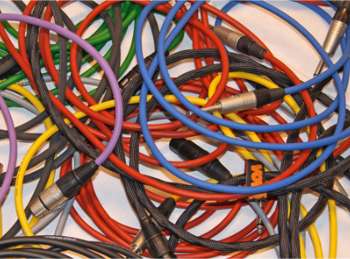
And if you're ready to take the plunge into the wonderful synthesized world of MIDI, then you'll want to bring your favorite MIDI Cables along for the ride.
Is your gear a little older??
Then you may already know a thing or two about RCA Cables.
Spend some time on the links above and you'll have this down in no time.
Check out my list of Recommended Cables if you'd like some help sorting all the options.
Booyah! Another trick to add to your ever increasing bag of tricks.
The Tale of the Expensive Cable
Now inevitably you will read online or hear from the local guitar-shop-guy about the importance of going for high-end gear.
They'll frighten you with stories of live show disasters and how the cheaper options won't hold up to the rigors of life on the road.
True! But this is not what we're about.
These are going to stay put in your house and post up within the protected walls of the new studio.
They won't have people stepping on them, they won't be hooked up and ripped out every night for 3 months, and they won't have cymbals dropped across them like a guillotine.
So having said that there are 3 things to consider in your quest for the perfect studio cable.
- Type
- Length
- Quality
1 - Type
These are the basic connector types we mentioned above.
Between the 1/4" Instrument, XLR, RCA, and MIDI types you'll be in good shape.
These are the heavy hitters and will satisfy nearly all of your studio cable needs.
These will be the interconnect between your guitar, keyboard, mics, mixer, direct boxes, pretty much anything you can think of.
With the exception of power cords and data cables (USB, FireWire, etc.) you can find everything you need here.
Instrument cables come in balanced and unbalanced varieties, while XLRs are balanced in all instances.
MIDI comes in one standard flavor so you can't go wrong there.
2 - Length
How long does a piece of string need to be? Just long enough to do the job and no longer.
In our case, I would say that in general anything longer than 12-15 feet gets to be unwieldy and frustrating.
For lines of ~15 ft or less you'll have negligible signal loss.
But let me also be clear, it's definitely better to have them too long than not long enough.
Don't go down the road of moving furniture and components because you went too short on your lines. That is a dark, dark place.
In the case of instrument cables that belong to a guitar, for example, going longer is key to not dragging down your mixing console when you are laying down a blazing electric riff.
Trust me, it has happened before.
In summary, go as short as you can to avoid piles of cable but as long as you need to in order to operate your gear comfortably.
Get the right size cable for the job and you will love your recording studio cable life.
3 - Quality
The expensive options will be more rugged, have higher quality gold components, TRS balanced connectors, and a lifetime warranty.
The cheaper alternatives will have nickel components, unbalanced connectors, and lower quality hardware.
And once again, despite what you will read in the impossible-to-satisfy authors of the online forums... there is no detectable difference in sound quality.
I have tried it myself.
I have listened for it. I have done tests searching for the proof to tip the scales one way or the other.
And in the end, I'm right back where I started.
The only way to know for sure is to hear it for yourself.
Any possible improvement in sound quality would require the highest standards in every other component in your system.
What are we?? A professional studio?!?
If a chain is only as strong as the weakest link, then the sound quality of your "audio chain" is only as strong as your noisiest link.
If you do decide to buy expensive studio cables... do it for the warranty.


